How to play checkers: rules, jumping and kings
Updated · 4 min read
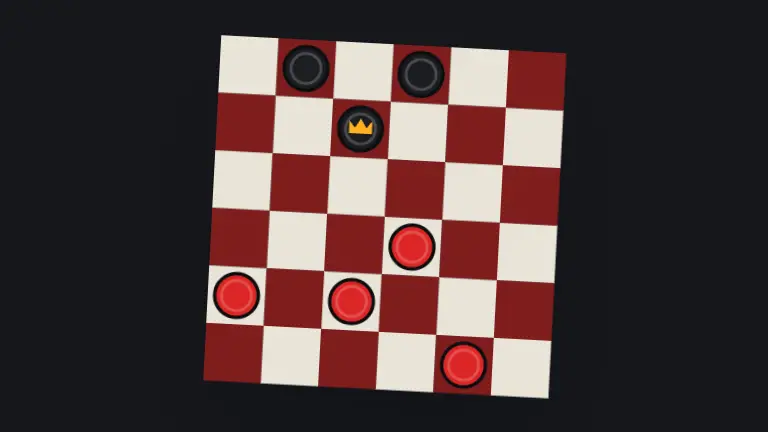
Checkers, also called draughts, is the board game many of us learned before chess. It uses the same 8-by-8 board, but every piece starts out the same and moves the same way, so the rules fit on an index card. The depth comes from one rule: if you can jump, you must. That turns every move into a little puzzle about what you are offering your opponent. Here are the standard American rules, common variations, and how our version plays.
What you need and the goal
Two players, an 8-by-8 board of alternating light and dark squares, and twelve pieces each, usually black (or red) and white. The goal is to capture all of your opponent's pieces, or leave them with no legal move.
Setup
Place the board so each player has a dark square in their bottom left corner. All play happens on the dark squares. Each player puts their twelve pieces on the dark squares of the three rows nearest them, leaving the two middle rows empty. In American checkers, black moves first.
How a turn works
- Moving: a regular piece, called a man, moves one square diagonally forward onto an empty dark square.
- Jumping: to capture, jump diagonally forward over an opponent's piece onto the empty square just beyond it. The jumped piece is removed.
- Multi-jumps: if, after a jump, the same piece can jump again, it must keep jumping in the same turn. A long chain of jumps can clear half the board.
- Forced captures: if any jump is available, you must take one. When several are available, you may choose which, and it does not have to be the longest.
Kings
When a man reaches the far row, it is crowned and becomes a king, traditionally by stacking a captured piece on top. A king moves and jumps diagonally both forward and backward, one square at a time. In American checkers, a man that reaches the far row during a jump is crowned and its turn ends there, even if it could have kept jumping as a king.
Why the forced jump matters
Because a capture is compulsory, you can make your opponent move a piece where you want it. The classic trick is the two-for-one: you deliberately leave a piece where it can be jumped, your opponent has no choice but to take it, and the jumping piece lands on a square where you can jump it, and often a second piece behind it, in return. Good players spend much of a game setting up and avoiding these shots. Before every move, look at each square your opponent could be forced to land on, not just the squares you are moving to.
The same rule protects you. A piece that cannot be jumped, because the square behind it is occupied or off the board, is safe no matter what your opponent wants. Pairs of pieces side by side and pieces backed up diagonally are hard to attack, which is why strong players move in compact groups rather than sending single pieces up the board.
How a game ends
You win when your opponent has no pieces left or cannot make any legal move, because every piece is blocked. A game can be drawn when neither side can make progress: players may agree to a draw, and tournament rules declare one after a long stretch with no captures and no crownings, or when the same position comes up again and again.
Common house rules and variations
- Optional jumping: many home games ignore the forced-capture rule. Some even let a player remove an opponent's piece that failed to jump, called huffing.
- Flying kings: in many countries, kings move any number of squares diagonally, like a bishop in chess.
- Backward captures: international draughts lets men capture backward too, and uses a 10-by-10 board with twenty pieces each.
- Longest jump required: some rule sets make you take the capture that takes the most pieces.
How checkers plays on Knockout
Our Checkers is classic American checkers, built from the standard rules above. From the game's code:
- Jumps are mandatory and multi-jumps must be finished, but you may pick any available capture, not necessarily the longest. Pieces that must capture glow red.
- Kings move one square at a time, forward or back. Being crowned ends the turn, even in the middle of a jump.
- Draws: 40 moves by each player without a capture or a crowning, the same position with the same player to move for the third time, or an accepted draw offer.
- The host picks who plays black, or leaves it to chance. A 5-minute clock per player is optional, and you can resign at any time.
- Against the computer and without a clock, Take back undoes your move and the reply. Moves are listed in standard notation, squares 1 to 32.
Beginner tips
- Keep your back row filled as long as you can. It stops your opponent from crowning a king.
- Before you move, check whether it offers a jump. Because jumps are forced, you can also use them to pull an opponent's piece out of position.
- Move toward the center. Pieces on the edge are safe from capture but have only one way to move.
- Trade pieces when you are ahead. An extra piece matters more and more as the board empties.
Where to play checkers free
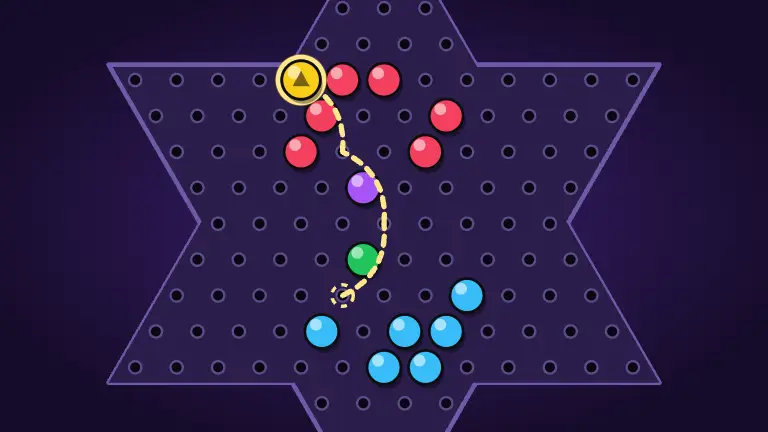
Checkers is free in a browser here. Playing the computer needs no account: open the game and pick Easy, Normal or Hard. To play a friend, make a free player (a username and a PIN or password), create a game and send the invite link or code.
When you want more pieces with more moves, Chess is the next step; read How to play chess: rules, moves and how to win. Star Checkers is a race for two to six players on a star-shaped board, hopping instead of capturing. More games for two are in The best 2-player games to play online.