How to play backgammon: rules, moves and scoring
Updated · 4 min read
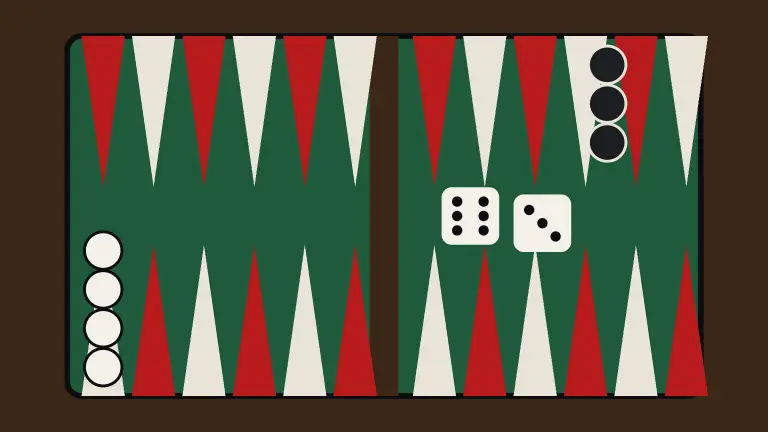
Backgammon is a race with a fight in the middle. Each player rolls dice and moves fifteen checkers around the board and off it, while trying to block and hit the other side. The dice add luck to any single game, but over a match the better player usually wins, which is why it has stayed popular for thousands of years. This guide covers the standard rules, the doubling cube, common variations, and how our version plays.
What you need and the goal
Two players, a backgammon board, fifteen checkers each in two colors, two dice for each player (or a shared pair), and optionally a doubling cube marked 2, 4, 8, 16, 32 and 64. The goal is to be the first to move all fifteen of your checkers into your home board and then bear them off the board.
The board and the setup
The board has 24 narrow triangles called points, in four quarters of six. Your home board is one quarter, holding your points 1 to 6. The two players move in opposite directions, each counting the points from their own side, so your 24 point is your opponent's 1 point. The strip down the middle is the bar.
- Two checkers on your 24 point, the farthest from home.
- Five checkers on your 13 point.
- Three checkers on your 8 point.
- Five checkers on your 6 point.
Your opponent sets up the mirror image. To start, each player rolls one die. The higher roll moves first, using both dice as rolled. On a tie, roll again.
How a turn works
- Roll both dice and move checkers forward by each number. You can move one checker by both numbers or two checkers by one each.
- Doubles count twice: a roll of 4 and 4 gives you four moves of 4.
- You may land on any point that is empty, holds your own checkers, or holds a single opposing checker. You may not land on a point with two or more opposing checkers.
- You must use as much of your roll as you legally can. If only one die can be played, you must play the larger one if possible.
Hitting and the bar
A single checker alone on a point is a blot. If your opponent lands on it, it is hit and placed on the bar. A player with a checker on the bar must bring it back in, entering on the opponent's home board according to the dice, before moving anything else. If the entry points are all blocked, you lose your turn. Building a row of blocked points, called a prime, is one of the strongest positions in the game.
Bearing off and scoring
Once all fifteen of your checkers are in your home board, you may start bearing them off. A roll of 3 removes a checker from your 3 point. If you roll higher than your highest occupied point, you may remove a checker from that highest point. If one of your checkers is hit while you are bearing off, you must bring it all the way around before bearing off again.
- A normal win: 1 point.
- A gammon, when the loser has not borne off any checkers: 2 points.
- A backgammon, when the loser has borne off nothing and still has a checker on the bar or in the winner's home board: 3 points.
The doubling cube and match play
Before rolling, a player may offer to double the stakes. The opponent either accepts, taking control of the cube so only they may double next, or declines and loses the game at its current value. In match play, games are played to a target such as 3, 5 or 7 points. Under the Crawford rule, the game right after a player first comes within one point of winning is played without the cube.
Common house rules
- Automatic doubles: a tied opening roll doubles the stakes.
- Beavers: a player who is doubled may immediately redouble while keeping the cube.
- The Jacoby rule: in money games, gammons count only if the cube has been used.
- No cube at all: many casual games skip doubling entirely.
How backgammon plays on Knockout
Our Backgammon follows the standard rules above, including gammons and backgammons. From the game's settings:
- A single game by default, or a match to 3 or 5 points.
- The doubling cube is off by default. When the host turns it on, takes, drops and the Crawford rule work as described. There are no automatic doubles, beavers or Jacoby rule.
- By default the higher opening roll moves first. The host can instead have the host or the guest start.
- An optional clock gives each player 5 minutes for the whole match, running only while it is their decision.
- Moves that break the use-your-dice rule are simply not offered. With Hints on, a ring suggests a checker to move.
Beginner tips
- Make points, not blots. Two checkers together are safe; one alone can be hit.
- Build points in front of your opponent's back checkers, especially your 5 and 7 points.
- Move your two back checkers out early, before your opponent builds a wall in front of them.
- Count the race. If you are well ahead in pips, stop fighting and run home safely.
Where to play backgammon free

Backgammon is free in a browser here. Against the computer you need no account: open it and play at Easy, Normal or Hard. To play a friend, make a free player (a username and a PIN or password), create a game and send the invite link or code.
For a strategy game with no dice at all, read How to play chess: rules, moves and how to win. For a card game that shares backgammon's pegging-race feel, read How to play cribbage: rules, pegging and counting. More head-to-head picks are in The best 2-player games to play online.