How to play spades: rules, bidding and scoring
Updated · 5 min read
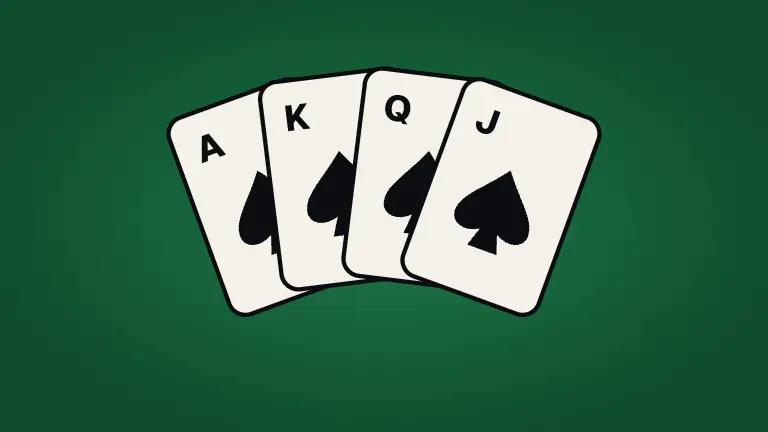
Spades is the partnership trick-taking game that fills dorm rooms, break rooms and family tables. The idea is simple: you and your partner say how many tricks you will take, then you go and take them. The catch is that taking too many is almost as costly as taking too few. This guide walks through the rules most people play, the variations you will meet, and how our version handles each one.
What you need and the goal
- Four players in two teams, partners sitting across from each other.
- A standard 52-card deck, no jokers. Cards rank ace high, down to 2, in every suit.
- A score sheet with a column for each team, and room to note bags.
The goal is to be the first team to reach the target score, commonly 500 points. Every hand, each team makes a contract and earns or loses points depending on whether they make it.
Setup and the deal
The dealer shuffles and deals the whole deck, one card at a time, so each player gets thirteen. The deal moves one seat to the left after every hand. Pick up your cards and sort them by suit; you will want to know at a glance how many spades and how many high cards you hold.
Bidding
Starting with the player to the dealer's left and going around once, everyone bids the number of tricks they expect to win, from zero to thirteen. Partners' bids are added together to make the team's contract. If you bid 4 and your partner bids 3, your team needs at least seven tricks between you.
A bid of zero is called Nil. It is a personal promise that you will not take a single trick. If you make it, your team earns a bonus; if you take even one trick, it costs the same amount. Some tables also allow Blind Nil, bid before looking at your cards for a doubled bonus or penalty, usually only for a team that is far behind.
A rough way to count your bid: one trick for each ace and for each king you can protect, plus one for every spade beyond the third, plus a trick for a short side suit you can trump. Then shade it down a little. Partners who overbid are the most common way games are lost.
How a hand works
The player left of the dealer leads the first trick. Everyone must follow the suit that was led if they can. If you cannot follow suit, you may play any card, including a spade. Spades are always trump: the highest spade played wins the trick, and if no spade was played, the highest card of the suit led wins. The winner leads the next trick.
Spades cannot be led until they are broken, meaning someone has played a spade on an earlier trick because they could not follow suit. The one exception is a player holding nothing but spades, who may lead one. After thirteen tricks the hand is scored and the next dealer deals.
Scoring
- Make your contract: 10 points for every trick bid, plus 1 point for each extra trick. Bid 6, take 8, and you score 62.
- Fall short: lose 10 points for every trick bid. Bid 6, take 5, and you lose 60.
- Extra tricks are called bags or sandbags. Every 10 bags a team collects costs 100 points, and the count starts over.
- Nil: 100 points if the Nil bidder takes no tricks, minus 100 if they take any. Blind Nil doubles both to 200.
When one partner bids Nil, the other partner's bid stands alone as the contract. Any tricks the Nil bidder accidentally takes still count toward that contract, even though they cost the Nil bonus.
Common house rules
- Game length: 500 is traditional, but 200 or 300 makes a shorter evening.
- Mercy rule: a team that falls to minus 200 loses on the spot.
- First lead: some tables have the 2 of clubs lead the first trick instead of the player left of the dealer.
- Jokers: some groups add two jokers (and remove two 2s) as the highest trumps.
- Minimum bid: some tables require a team to bid at least four between them, or forbid Nil entirely.
How spades plays on Knockout
Our Spades plays the standard rules above. From the game's own settings and scoring:
- The host picks the target: 200, 300 or 500 (the default). A team at minus 200 or below loses, and if both teams finish level another hand is played.
- Nil is on by default; the host can turn it off. Blind Nil is off by default and, when on, is open only to a team that is 100 or more points behind.
- Ten bags cost 100 points, and bags carry from hand to hand.
- The player left of the dealer leads the first trick, and there are no jokers.
Beginner tips
- Bid what you can take, not what you hope for. Missing a contract by one trick swings the score by far more than a bag.
- Watch your partner's bid before you make yours. If they bid high, you can bid tight and play to help.
- Cover your partner's Nil. Play high cards on the suits they lead and win tricks they might be stuck with.
- Count spades as they fall. Knowing how many are left tells you when your king or queen will finally win.
- Late in the game, check the bag count. Near nine bags, deliberately losing a trick can be worth more than taking it.
Where to play spades free
Spades is free in a browser here. Against the computer you need no account: open it and computer players fill the other three seats at Easy, Normal or Hard. To play with friends, make a free player (a username and a PIN or password), create a game and send the invite link or code. Empty seats can still go to computer players, so you and one friend can take on a pair of bots.
If bidding is your favorite part, Oh Hell makes every bid exact, and Euchre is a faster partnership game with a short deck; see How to play euchre: rules, scoring and strategy. For trick-taking without partners, read How to play hearts: rules, passing and shooting the moon, and for the whole shelf, Free card games online: classics, partners and party decks.