How to play solitaire (Klondike): rules and scoring
Updated · 4 min read
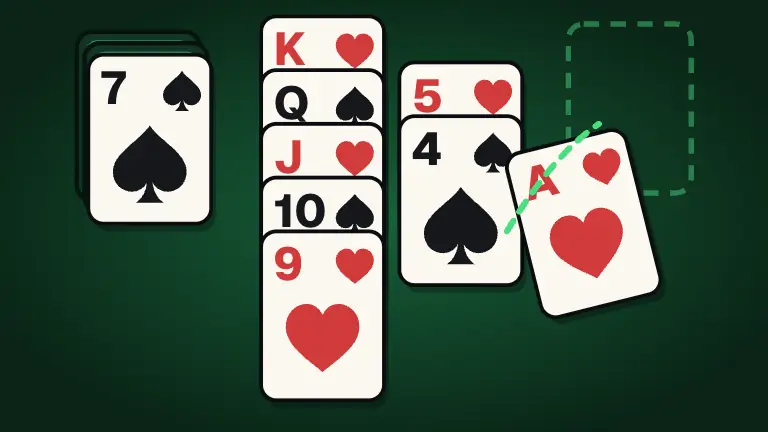
When most people say solitaire, they mean Klondike: seven columns of cards, a stock to turn through, and four piles to build from ace to king. It is the game that has filled more coffee breaks than any other, and it rewards a little planning more than you might expect. This guide explains the rules, the common variations, and how our version works.
What you need and the goal
One player and one standard 52-card deck. The goal is to move all 52 cards onto four foundation piles, one per suit, each built up in order from ace to king. If you get every card home, you win the deal.
Setup: the layout
Deal seven columns, called the tableau, from left to right. The first column gets one card, the second two, and so on up to seven cards in the last column. Only the top card of each column is face up; the rest are face down underneath. That uses 28 cards. The remaining 24 go face down as the stock. Leave room above the columns for the four foundations, which start empty.
How play works
- Building in the columns: you may place a card on a face-up card one rank higher and of the opposite color. A red 7 goes on a black 8, a black jack on a red queen.
- Moving runs: a properly built sequence, like black 8, red 7, black 6, can move together onto another column, as long as its top card fits.
- Turning cards: when you move the last face-up card off a column, turn the face-down card below it face up.
- Empty columns: only a king, or a run starting with a king, can fill an empty column.
- Foundations: any ace can start a foundation. After that, add the next card of the same suit: 2 on the ace, 3 on the 2, and so on to the king.
When you run out of useful moves on the table, turn cards from the stock onto a face-up waste pile. The top card of the waste is always available to play onto a column or a foundation. In draw one you turn one card at a time. In draw three you turn three at a time and can only play the top one of those three, which makes the game noticeably harder. When the stock is empty, turn the waste pile over to make a new stock and keep going.
Scoring
Many people simply play to win or lose a deal. Two scoring systems are common:
- Standard: points for moving cards to the foundations, from the waste to the columns, and for turning cards face up, with penalties for taking cards back off a foundation and for recycling the stock.
- Vegas: you pay a stake for each deal and earn a fixed amount for every card on a foundation. You get only a limited number of passes through the stock, so every turn of the card matters.
Common house rules
- Draw one or draw three: the biggest single choice. Draw one wins far more often.
- Limited passes: some players allow only one pass through the stock in draw one, or three in draw three.
- Any card in an empty column: a looser rule that makes the game much easier.
- Taking cards back: many players allow moving a card down from a foundation to a column when it helps; some forbid it.
How solitaire plays on Knockout
Our Solitaire has Klondike as its first mode (it also holds FreeCell and Spider). From the game's own rules:
- Draw one or draw three, and you may turn the waste over as often as you like. Only a king or a run starting with one fills an empty column.
- Standard scoring is 10 points for a card to a foundation, 5 from the waste to a column, 5 for every card turned over, minus 15 for a card taken back off a foundation, and minus 100 (draw one) or 20 (draw three) for each pass through the stock.
- Vegas scoring, on practice deals: a deal costs $52 in play money and every card home pays $5, with one pass through the stock drawing one or three passes drawing three. Winnings carry from deal to deal.
- The Daily Deal is the same for everyone each day, has been checked by a solver so it can be won, and always plays standard rules.
- Undo is unlimited, Hint lights up a useful move, and once every card is face up the game finishes itself.
Beginner tips
- Turn over face-down cards first. A move that uncovers a hidden card is almost always better than one that does not, and the longest columns hide the most.
- Do not empty a column unless you have a king ready to fill it.
- Do not rush cards to the foundations. A low red card on a foundation might be the only home for a black card you need to move later.
- Before turning the stock, look for every move on the table. The stock is your fallback, not your first move.
Where to play solitaire free
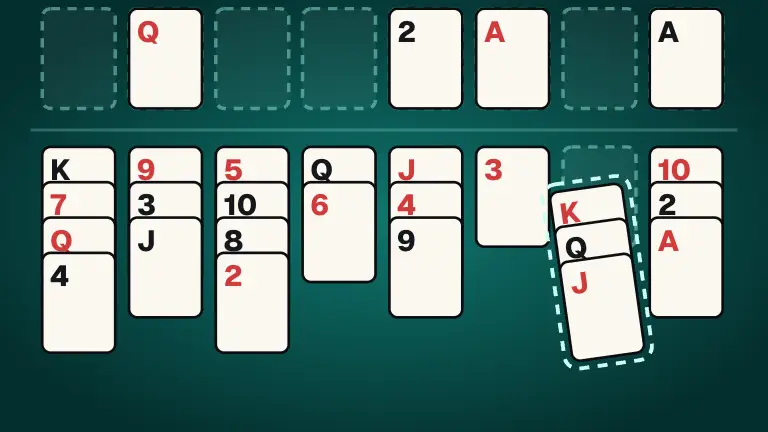
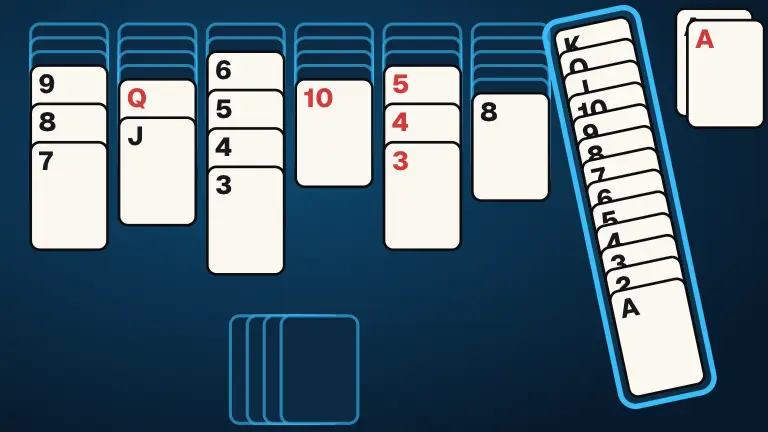
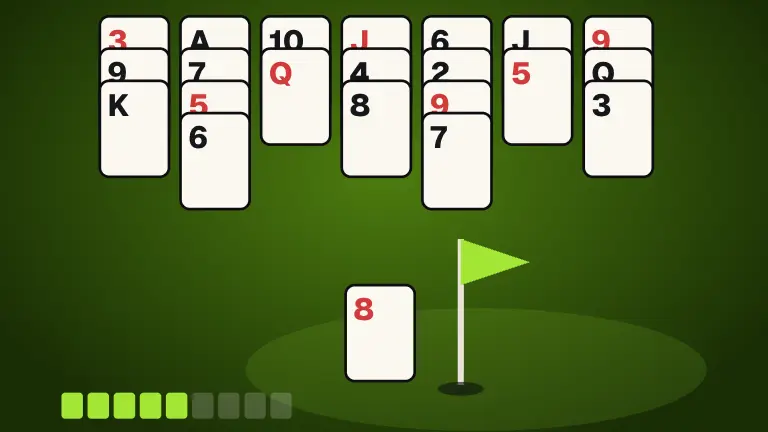
Solitaire is free in a browser here, with no account and no sign-up; it is a solo game, so there are no computer players or friends to invite, just you and the deal. Your stats and daily streak are kept on your device.
When Klondike gets familiar, FreeCell deals every card face up so nearly every deal can be won (see How to play FreeCell: rules, free cells and strategy), and Spider Solitaire uses two decks (see How to play Spider Solitaire: rules for 1, 2 and 4 suits). Golf Solitaire and the other variants are compared in Free online solitaire: which one to play and how to win.